
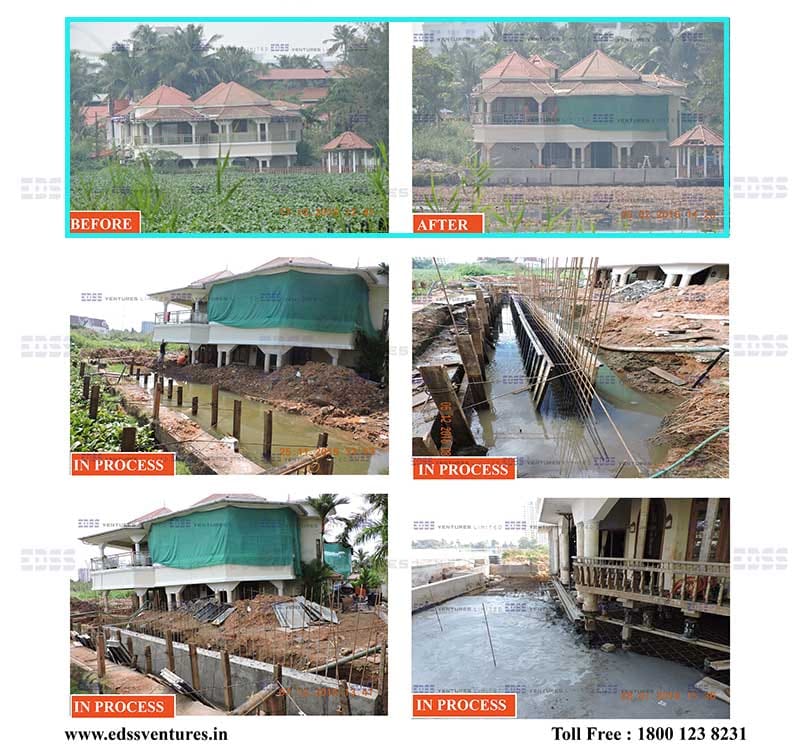
The purpose of buildings is to stand tall and stable. Yet, in the course of time, there are some buildings that undergo such changes in position as to bend, lean, or misalign vertically due to things like foundation issues, soil settlement, structural harm, or even natural calamities. These changes affect the structure’s safety, and at the same time, they reduce the building’s life and usability.
Realignment engineering is the progressive technique that allows the restoration of these buildings by positioning them back to the vertical alignment they have lost, thus saving the structure from demolition. Using advanced technology, engineers can lift, tilt, and realign buildings safely bringing them back to perfect alignment with minimal disruption.
The post you are reading is to explain how realignment engineering works, why it’s needed, and how it ensures the long-term safety of leaning or inclined buildings.
Table of Contents
- What Is Realignment Engineering?
- Why Do Buildings Lean or Incline?
- How Realignment Engineering Straightens Leaning Structures
- Key Technologies Used in Realignment
- Benefits of Realignment Over Reconstruction
- When Should You Consider Realignment?
- Conclusion
- FAQs
1. What Is Realignment Engineering?
Realignment engineering is a specialized process in which engineers straighten a leaning, bent, or inclined structure by adjusting its foundation and superstructure.
The objective is to regain its old vertical position, enhance stability, and avoid further tilting of the building without demolishing it. It is also commonly used in cases of building settlement, helping restore the structure without the need for demolition.
2. Why Do Buildings Lean or Incline?
There are numerous factors that can contribute to misalignment in buildings, including:
- Soil settlement or erosion
- Weak or damaged foundation
- Poor building design and/or workmanship practices used during constructions
- Heavy rainfall, flooding or seismic activity
- Vibration from construction or traffic in the surrounding area
- Aging or damaged structural materials.
If the cause of a building’s tilt is not resolved, it may continue to get worse over time, leading to potential collapse of the building structure.
3. How Realignment Engineering Straightens Leaning Structures
The entire realignment process goes through a number of very important stages:
- a) Structural Assessment
Engineers examine the building, foundation, and soil to determine the cause of and the extent of the lean.
- b) Redistribution of load
Temporary supports or jacks are put in place that reduce pressure on the weak areas.
- c) Jacking and Lifting
Engineers slowly lift leaned part of the building using hydraulic jacks. This is done millimeter by millimeter in order to avoid any cracks or stress.
- d) Foundation Strengthening
Methods such as micro-piling, under-reamed piles, or grouting are used to develop a better base.
- e) Verification of Alignment
Laser-leveling tools and digital sensors ensure that the building will be restored in perfect vertical alignment.
- f) Final Stabilization
Engineers then secure the structure permanently to prevent any future leaning.
4. Key Technologies Used in Realignment
- Hydraulic jacking systems
- Laser and digital tilt sensors
- Soil stabilization techniques
- Micro-piling and underpinning
- Geotechnical monitoring tools
These technologies ensure precision, safety, and long-term stabilization
5. Benefits of Realignment Over Reconstruction
- Affordable in relation to building demolition.
- Faster project completion
- Preserves existing structure and architecture
- Increases building lifespan
- Safe and least disruptive
- Environmentally friendly: no debris or reconstruction waste
6. When Should You Consider Building Realignment?
You should seek professional realignment services if you observe:
- Visible leaning or tilting
- Cracks in the walls and floors
- Uneven doors or windows
- Gaps between walls and floors
- Subsidence or sudden sinking
Early intervention minimizes risks and reduces repair costs.
Conclusion
Realignment engineering is one extremely effective method of straightening a leaning, bent, or inclined building. By using precise technology and expert structural assessment, engineers and building contractors are able to give a building vertical alignment once again, thereby strengthening the foundations to ensure long-term stability-all without major demolition or reconstruction.
Realignment is the safest way to protect your tilted building for decades if the building has already begun to tilt.
Need Help Straightening Your Leaning Building?
Frequently Asked Questions
Sure, Realignment is made to be safe for old structures and frequently used to keep heritage buildings.
In accordance with tilt severity, the time required may range from a few days to a few weeks.
To ensure that no cracks occur, the procedure is executed very slowly and accurately. Engineers observe movement in real time.
Definitely, Realignment is way cheaper than dismantling and reconstructing a building.
Author

EDSS Ventures Limited is a technology-driven engineering and construction company established in 2003 and transitioned into a public limited company in 2022. The company specializes in innovative civil engineering solutions that focus on repairing, strengthening, and transforming existing structures instead of rebuilding them. Its expertise includes building restructuring, foundation strengthening, correction of tilted structures, lifting and shifting engineering, and restoration of heritage and monumental buildings. EDSS Ventures also delivers advanced waterproofing systems and vertical parking solutions with both automated and manual options. With a strong commitment to sustainability, the company adopts resource-efficient methods that minimize environmental impact while delivering high-quality, customized engineering outcomes.
