
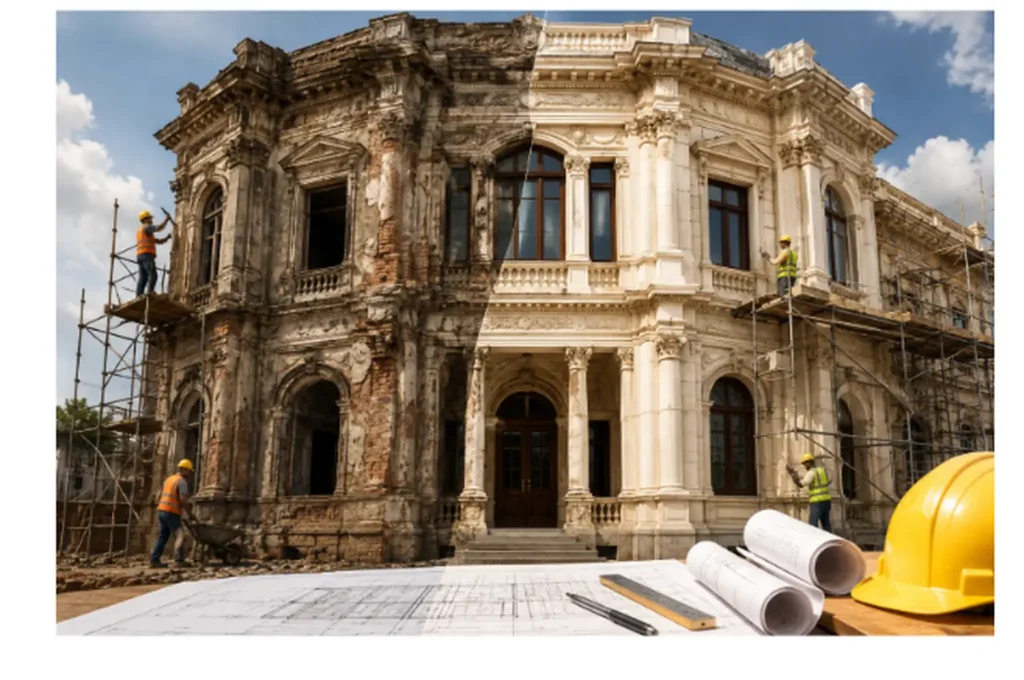
Introduction
Buildings of worth are more than just the physical structure. Heritage buildings, historic buildings, aged commercial buildings, institution buildings, and architecturally significant buildings often reflect the culture, history, and craft of a community. But the process of aging, exposure to the elements, moisture, changing loads, maintenance issues, and structural decay can slowly compromise their structural integrity and aesthetics.
Building restoration is a process by which repairs and reinforcements can be carried out in a way that retains as many of the existing parts of the structure as possible. The solution to dealing with an aging building is not always demolition but restoration.
For property owners, developers, institutions, and heritage stakeholders, working with an experienced construction company in Kochi can help ensure that structural assessment, restoration planning, and construction work are approached systematically.
Table of Contents
- The Role of Structural Restoration
- Why Valuable Buildings Need Structural Restoration
- Common Causes of Structural Deterioration
- Identifying Structural Problems Early
- How Structural Restoration Preserves Buildings
- Structural Strengthening and Repair Techniques
- The Role of Restoration and Lifting Engineering
- When Building Lifting May Be Required
- Benefits of Professional Structural Restoration
- Planning a Structural Restoration Project
- Challenges in Restoring Older Buildings
- Maintenance After Structural Restoration
- Conclusion
- FAQ
1. The Role of Structural Restoration
Structural restoration refers to the process by which a structure on an existing building that has deteriorated is repaired or improved. Unlike traditional building projects, restoration projects begin with a pre-existing structure. It is likely that the building has a lot of history in terms of deterioration, alterations, renovations, or weathering.
A restoration project may involve:
- Structural inspection
- Condition assessment
- Crack repair
- Masonry strengthening
- Concrete repair
- Foundation rehabilitation
- Structural reinforcement
- Load-bearing element repair
- Waterproofing and moisture control
- Building stabilisation
- Structural lifting or repositioning where required
The objective is to improve structural performance while preserving the building’s important architectural and functional characteristics.
2. Why Valuable Buildings Need Structural Restoration
Older or valuable buildings can deteriorate for many reasons. Leaving structural problems unaddressed may increase repair costs and potentially compromise safety.
Preserving Architectural Character
Restoration can help retain original architectural features rather than replacing an entire structure with a new building.
Extending the Building’s Life
Properly planned repairs and strengthening can help an existing building remain functional for many more years.
Protecting Historical Value
Historic structures may contain architectural details, traditional materials, and construction techniques that are difficult or impossible to reproduce exactly.
Improving Safety
Structural deterioration can affect the stability of walls, floors, roofs, foundations, and other components. Professional restoration can address identified weaknesses.
Reducing Unnecessary Demolition
Where a building remains structurally viable, restoration may provide an alternative to complete demolition and reconstruction.
3. Common Causes of Structural Deterioration
Understanding why buildings deteriorate is essential for developing an effective restoration strategy.
Moisture and Water Ingress
Persistent water exposure can damage concrete, masonry, timber, finishes, and reinforcement. Poor drainage, leaking roofs, plumbing problems, and inadequate waterproofing can accelerate deterioration.
Corrosion of Reinforcement
In reinforced concrete structures, moisture and environmental exposure can contribute to corrosion of embedded steel reinforcement. Corrosion can cause expansion, cracking, and concrete spalling.
Foundation Movement
Changes in soil conditions, drainage, nearby construction, or foundation performance can contribute to settlement or movement.
Cracks and Structural Damage
Cracks may develop because of settlement, thermal movement, overloading, material deterioration, or other factors. Not every crack indicates a serious structural problem, but significant or progressive cracking requires professional assessment.
Age-Related Deterioration
Materials naturally experience wear over time. Without appropriate maintenance, small defects can develop into larger structural concerns.
Unplanned Modifications
Removing walls, adding floors, changing room layouts, installing heavy equipment, or making other modifications without proper structural evaluation can affect load distribution.
4. Identifying Structural Problems Early
Early identification can make restoration more manageable and may help prevent minor defects from becoming extensive damage.
Warning Signs May Include:
- Persistent or widening cracks
- Sagging floors or roofs
- Dampness or water infiltration
- Concrete spalling
- Exposed reinforcement
- Bulging or leaning walls
- Uneven floors
- Sticking doors and windows
- Visible foundation movement
- Unusual vibrations
- Deteriorating masonry
A visual inspection can identify obvious signs, but determining the cause of structural damage may require detailed investigation and professional engineering assessment.
5. How Structural Restoration Preserves Buildings
Structural restoration is not simply about repairing visible damage. A successful project addresses the underlying causes of deterioration.
Structural Assessment
Engineers assess the building’s condition and identify vulnerable areas.
Diagnosis of the Problem
The cause of damage must be understood before selecting a repair method. For example, repairing a crack without addressing ongoing water ingress may not provide a lasting solution.
Targeted Repairs
Where possible, restoration focuses on the affected components rather than unnecessarily replacing sound structural elements.
Structural Strengthening
Weak structural components may be strengthened to improve their load-bearing capacity and performance.
Protection Against Future Damage
Waterproofing, drainage improvements, corrosion protection, and other preventive measures can help reduce future deterioration.
Preservation of Existing Features
Restoration can aim to retain original materials and architectural details wherever technically and practically possible.
6. Structural Strengthening and Repair Techniques
The appropriate repair method depends on the building’s construction, age, materials, damage, and intended future use.
Possible techniques may include:
Concrete Repair
Damaged or deteriorated concrete can be repaired after identifying the underlying cause.
Reinforcement Repair
Where reinforcement has corroded or become exposed, appropriate repair and protection measures may be required.
Crack Repair
Selected cracks may be repaired using suitable techniques after determining whether they are structural, non-structural, active, or dormant.
Masonry Strengthening
Older masonry walls may require localised repair or strengthening depending on their condition.
Foundation Strengthening
Where foundation performance is inadequate, specialised strengthening techniques may be considered following a detailed assessment.
Waterproofing
Controlling water penetration can be an essential part of protecting restored structural elements.
The selected solution should always be based on an engineering assessment rather than applying the same method to every building.
7. The Role of Restoration and Lifting Engineering
Some restoration projects are associated with complexities which cannot be sorted out through regular structural repairs only. In some instances, a pre-existing structure may require stabilization, shifting, uplifting or any other such modification without demolition.
ReStoration Engineering in Kochi can come in handy in assessing the pre-existing structures and coming up with solutions related to engineering. This is because restoration entails careful planning since a pre-existing structure behaves differently from the new one.
8. When Building Lifting May Be Required
Building lifting is a specialised engineering process in which an existing structure is carefully raised to a planned level using controlled techniques.
It may be considered in situations such as:
- Raising a building above flood-prone levels
- Correcting certain level-related issues
- Accommodating changes in surrounding ground levels
- Preserving an existing structure where rebuilding would be undesirable
- Addressing selected foundation or elevation requirements
ReStoration Engineering requires careful structural analysis, lifting calculations, temporary support planning, equipment selection, and continuous monitoring.
Building lifting should never be treated as a simple construction activity. It requires specialist engineering expertise and detailed risk management.
9. Benefits of Professional Structural Restoration
A professionally planned restoration project can offer several benefits.
Preserves Existing Structures
Restoration allows valuable buildings to continue serving their intended purpose where feasible.
Retains Architectural Identity
Original design elements and building character can often be preserved.
Improves Structural Performance
Strengthening and repairs can address identified weaknesses and improve the building’s condition.
Supports Sustainable Construction
Reusing an existing structure can reduce the need for complete demolition and reconstruction, depending on the project.
Protects Investment
Restoration can help property owners protect the value and usability of an existing building.
Enables Adaptive Reuse
Older buildings can sometimes be restored and adapted for new uses while retaining important structural and architectural characteristics.
10. Planning a Structural Restoration Project
A successful restoration project requires careful planning from the beginning.
Step 1: Initial Inspection
The building should be inspected to identify visible defects and areas requiring further investigation.
Step 2: Detailed Structural Assessment
Engineers assess structural elements, materials, foundations, load conditions, and deterioration.
Step 3: Restoration Strategy
A suitable restoration and strengthening strategy is developed based on the assessment.
Step 4: Technical Planning
Engineering drawings, calculations, repair specifications, safety procedures, and project requirements are prepared as appropriate.
Step 5: Execution
Restoration work is carried out using suitable materials, equipment, and construction methods.
Step 6: Quality Monitoring
The work should be monitored to ensure that repairs and strengthening measures meet the required technical standards.
Step 7: Final Assessment
After completion, the restored structure should be reviewed and documented as appropriate.
11. Challenges in Restoring Older Buildings
Restoration projects can be more complex than new construction because the existing structure may contain unknown conditions.
Common challenges include:
- Hidden structural deterioration
- Inconsistent construction materials
- Previous unrecorded modifications
- Restricted access
- Difficult working conditions
- Heritage preservation requirements
- Moisture-related damage
- Uncertain foundation conditions
- Need to maintain the building during restoration
Proper investigation and coordination between engineers, architects, contractors and the owners of property can be used to handle some of these problems.
In the case of ReStoration and Lifting Engineering in Kerala projects, knowledge about the structure of the building becomes even more crucial.
12. Maintenance After Structural Restoration
Restoration should not be considered the end of structural care. Regular maintenance is essential for protecting the work that has been completed.
Recommended Maintenance Practices
- Inspect the building periodically.
- Monitor existing cracks for changes.
- Check roofs and drainage systems.
- Address water leakage promptly.
- Inspect exposed structural elements.
- Maintain waterproofing systems.
- Avoid unauthorised structural modifications.
- Investigate unusual movement or settlement.
- Schedule professional inspections when necessary.
Regular maintenance can help identify new problems early and protect the long-term performance of the restored building.
Conclusion
Restoration of buildings offers a practical method of safeguarding buildings and making them more safe, functional, and durable. The traditional idea of replacing an old building with another does not apply when one considers restoration, which involves the assessment of the condition of a building before carrying out suitable repairs and improvements.
Whether it is concrete and masonry repair, foundation reinforcement, or special lifting, each project requires different measures that depend on the condition, design, and function of a building.
Assessment, engineering, craftsmanship, and maintenance are some of the key factors in the success of restoration projects. Proper planning allows for the preservation of a building and continued use by future generations.
Protect your valuable structure with careful assessment, restoration, and engineering solutions.
Frequently Asked Questions
Structural restoration refers to the evaluation, repair, and reinforcement of an existing structure for improved structural condition and extended use.
It may need structural restoration in case it is in poor structural condition due to deterioration, structural cracks, settlement, rusting, dampness, or other problems.
Yes. An old building can be reinforced based on its condition and method of construction.
No. There are some cracks that may not necessarily have anything to do with a building’s structural integrity.
Building lifting is a specific engineering procedure whereby an existing building is elevated to a specified height with the use of certain lifting and support systems.
If applicable, elevation of an existing building may be seen as one of the measures for the prevention of floods. The viability of this method will depend on several factors related to the building itself, its foundation, location, etc.
Water may lead to such consequences as corrosion, deterioration of masonry and concrete, decay of timber, formation of molds, etc. One of the crucial steps of restoration will be identifying the sources of moisture.
The answer will be determined by various factors including the age, state, function, environment, etc. of the building and the restoration measures performed previously.
Author

EDSS Ventures Limited is a technology-driven engineering and construction company established in 2003 and transitioned into a public limited company in 2022. The company specializes in innovative civil engineering solutions that focus on repairing, strengthening, and transforming existing structures instead of rebuilding them. Its expertise includes building restructuring, foundation strengthening, correction of tilted structures, lifting and shifting engineering, and restoration of heritage and monumental buildings. EDSS Ventures also delivers advanced waterproofing systems and vertical parking solutions with both automated and manual options. With a strong commitment to sustainability, the company adopts resource-efficient methods that minimize environmental impact while delivering high-quality, customized engineering outcomes.
