
Three-Time International BUILD Award Winner (2024–2026).  Recognized by BUILD Magazine, United Kingdom, for Excellence in Structural Engineering, Building Restoration, Realignment, Restructural Engineering, and Environmental Sustainability.  2024 - https://www.build-review.com/winners/edss-ventures-limited/ , 2025- https://www.build-review.com/winners/edss-ventures-limited-2/, 2026- https://www.build-review.com/winners/edss-ventures-limited-3/  . Member of the Indian Green Building Council (IGBC) | Membership No. IGBCCS260808

EDSS

Building Remodeling

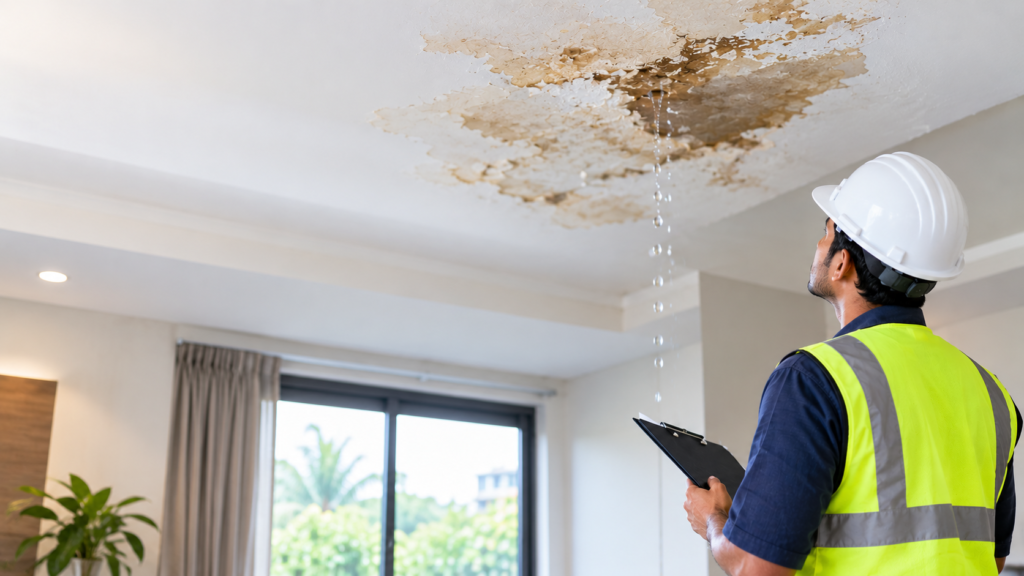
What Happens Inside a Building When the Roof Starts Leaking  

Introduction A roof that leaks may seem like a small problem, but it can slowly damage many parts of a building. Also, roof leakage can hurt ceilings, walls, electrical systems, and even the strength of some building parts. Early inspection and proper repair can stop costlier damage. A construction company in Kochi can examine the cause of roof leakage. Recommend the correct repair solution. Table of Contents How Does Roof Leakage Start? How Does Roof Leakage Damage Walls and Ceilings? Can Roof Leakage Affect Electrical Systems Can It Damage the Building Structure? Why Should Roof Leaks Be Repaired Early? How Can a Construction Company Be of Assistance? Conclusion  FAQ How Does Roof Leakage Start? A leaky roof usually starts when water finds its way into a weak or damaged area of the roof. Possible reasons include: Cracks in the Roof Waterproofing Damage Blocked Drains Broken Tiles Bad Drainage In the long run, constant rain and poor maintenance may contribute to the development of such issues. Regular inspection may help to prevent any damage inside the house. 2. How Does Roof Leakage Damage Walls and Ceilings? If there is water leakage from the roof, it may first damage the ceiling and then the adjoining walls. Water Staining: Brown stains may be seen on both the ceiling and walls. Peeling Paint: Water leakage makes the paint bubble and peel off. Wet Spots: Ceilings and walls may stay wet for a while. Mould growth: Due to continuous water, mould may form. Loose Plaster: Water leakage may make the plaster loose. The damage may spread if the leakage is not repaired early. 3. Can Roof Leakage Affect Electrical Systems Yes. Water from the roof leak can penetrate electrical wiring, switches, and other electrical fixtures. This can create safety risks and damage electrical components.  Wet Wires: Water can enter the electrical wiring. Damage Switches: Water can damage the switches and other electrical fixtures. Short Circuit: There could be a possibility of a short circuit due to the presence of water near the electrical connections. Failure of Electrical Appliances:  The leakage of water can cause failure of electrical appliances. In case there is any water in the vicinity of the electrical connections, the power supply must be shut down. 4. Can It Damage the Building Structure? Yes, persistent roof leaks may impact certain building structures, particularly where there is continuous presence of moisture. Steel Corrosion:  The steel structure may corrode due to moisture. Poor Concrete:  The concrete structure may be affected by moisture, especially if it is damaged. Loosened Plaster:  Moisture may cause loosening of the plaster material from the walls or ceiling. Wood Damage:  Wooden structures may absorb moisture, leading to weakening of the structures. Increase in Cracks: Cracks may become more visible with time. Inspection and repair are recommended. 5. Why Should Roof Leaks Be Repaired Early? A small roof leak can cause bigger issues if not addressed on time. Early repair is necessary in order to protect the building and avoid further repair expenses. Avoids Additional Damages: Stops water from spreading to other parts. Maintains the Structure:  Prevents future damage to concrete, metal, etc. Avoids Mould Formation:  Stops the damp area from turning into a mould colony. Saves Repair Money:  It is easier to fix a small leak than water damage. Ensures Safety: Helps prevent safety risks associated with ceiling and electrical system problems. Roof inspection allows detection of leakage at an early stage. 6. How Can a Construction Company Be of Assistance? A professional team of construction experts can diagnose the problem with your roof and recommend the appropriate repair option. Waterproofing solutions can also help protect the roof from further water damage.   Roof inspection: Identifies any cracks, damage, or weak spots in the roof. Detection of leaks: Locates the point of water infiltration. Waterproofing: Prevents any additional water leaks. Repairs: Fixes the roof and all affected areas. Structural evaluation: Detects if there is any structural damage caused by the roof leak. Inspection and timely repairs can help prevent further damage and costly future repairs. Conclusion Roof leakage may start as a small problem, but it can gradually affect the ceiling, walls, electrical systems, and building structure. Early inspection, proper repair, and Aqua Repel Service in Kerala can be used for waterproofing; this will help protect the building from further water damage. Need Help With Roof Leakage? Call Us Frequently Asked Questions 1. What are the typical reasons behind roof leakage? Typical reasons include roof cracks, damaged waterproofing, clogged drains, damaged tiles, and drainage problems. 2. Does roof leakage have an impact on walls and ceilings? Yes, roof leakage may result in stains, peeling paint, mould, and loose plaster. 3. Can roof leakage harm electrical wiring? Yes, since water can damage electrical wires, switches, and other electrical equipment. 4. Can roof leakage lead to structural damage? Leakage will damage the following materials over time: concrete, steel, plaster, and wood. 5. Why fix roof leakage quickly? This will help avoid additional damage and minimize future costs. 6. Will Aqua Repel stop water leakage? Aqua Repel can be used as a waterproofing service to protect the surfaces from water penetration. 7. How can roof leaks be identified? A professional inspection will allow you to discover the cause of leaks, cracks, and weak points.

What Happens Inside a Building When the Roof Starts Leaking   Read More »

What Causes Building Settlement and How Can It Be Corrected? 

Introduction A building is built to carry its weight down through the foundation and into the ground. When the soil under a building changes, loses strength, gets squeezed unevenly, or cannot hold the load it is given, the building can start to sink or shift from where it was originally placed. This slow sinking or shifting is called building settlement. Settlement does not always mean that a building must be torn down or rebuilt. The right fix depends on what caused the problem , how bad it is, where it is , and how the movement is spreading. Looking at the issue early can help figure out if the problem comes from the soil, the foundation, drainage, mistakes during construction , or changes happening around the property. Knowing exactly what caused the settlement is very important, especially for a construction company in Kochi, as it helps determine the right method to correct the problem and prevent further structural issues. Table of Contents Why Buildings Settle: A Simple Explanation Ground and Foundation Factors That Cause Settlement Warning Signs of Building Movement Engineering Investigation and Diagnosis of Settlement Methods Used to Correct Building Settlement When Building Realignment Is Needed Why Professional Engineering Intervention Matters for Buildings Conclusion FAQs 1. Why Buildings Settle: A Simple Explanation Settlement can happen naturally after construction. The soil under a building shifts to bear the weight. This is fine when the settlement is small and spread evenly. Problems start when the settlement is significant or uneven. Parts of a building can move at speeds that make walls, floors, columns, beams, and other parts tense. Uneven movement can slowly change the shape of the building, leading to cracks, warped floors, openings , or gaps between structural and non – structural parts. The main worry is not just that a building has experienced settlement , but why it has experienced settlement and whether the settlement continues . 2. Ground and Foundation Factors That Cause Settlement Weak or Compressible Soil I have noticed that certain soil types compress significantly under long – term loads. When weak or compressible soil fails to provide support across the foundation, some parts may settle faster than others. Poorly Compacted Fill I have seen buildings constructed on compacted fill that settle more as the fill consolidates over time. This becomes obvious when foundations cross areas with differing ground conditions. Changes in Groundwater Changes in groundwater levels can affect how soil behaves. Water movement , long – term saturation, or sudden shifts in moisture can lower soil stability and change its load – bearing capacity . Drainage and Water Leakage Water that remains near foundations can wash away soil particles, soften the ground, or cause erosion. Leaking plumbing and poor surface drainage contribute to this problem. Foundation – Related Problems If the foundation is too shallow , poorly designed, deteriorating, or spreading load unevenly, it can cause movement as well . Changes Around the Property Excavation , nearby construction work, changes to drainage, or additional loads added near an existing structure can alter the ground conditions. 3. Warning Signs of Building Movement Settlement can show itself in clear signs. Common indicators include: – Cracks around doors and windows – Cracks that get wider over time – Sloping or uneven floors – Doors and windows that are hard to open or close – Gaps between walls, ceilings , or floors – Separation between extensions and the original structure – Visible tilting or movement of structural parts – Cracks appearing next to areas that were previously repaired One single crack does not always mean that the foundation is moving badly. But when cracks keep growing , show up in spots, or when the building’s alignment changes noticeably, it is best to have a professional look at the situation. 4. Engineering Investigation and Diagnosis of Settlement Before corrective work begins, engineers must find the cause of the movement. Treating the visible cracks can provide a short – term fix, but it does not solve the problem underneath. A professional investigation may include inspection-level measurements, crack monitoring, an examination of structural elements, a foundation assessment, and an evaluation of the surrounding soil and drainage conditions. Depending on the building and the site , engineers may also need a soil investigation or other technical testing. These measurements help determine whether the structure has moved vertically, horizontally, or in other ways, and whether the movement is still happening or has become stable. This diagnosis then becomes the foundation for choosing the right correction strategy. 5. Methods Used to Correct Building Settlement No single method works for every settlement problem. The corrective approach depends on the condition of the building , the type of foundation, the soil characteristics, and the amount of movement that has occurred. Possible engineering solutions may include strengthening the foundation , underpinning, improving the soil, correcting drainage, redistributing load, or repairing the structure. When the building has moved far from its position , Building Realignment  solutions may be considered to carefully restore the structure closer to its former alignment. The correction process must be planned based on movement rather than assumptions. Improper lifting, unsupported intervention , or uncontrolled correction can add stress to the structure. 6. When Building Realignment Is Needed Settlement can lead to more than a straight downward shift. When foundations move unevenly, parts of a building might start to lean, tilt, or shift out of place from how they were built. In some cases, fixing cracks alone is often not enough. It doesn’t solve the problem underneath. That’s where a building settlement in Kochi  becomes important. It helps decide if the building needs stabilization, foundation work, realignment , or a mix of engineering solutions. Realignment work is done with care and precision. It’s not about making the building look good on the outside. The goal is to fix the movement, keep the structure stable, and avoid adding more stress to the building. 7. Why Professional Engineering Intervention Matters Settlement correction is not a cosmetic fix-it’s

What Causes Building Settlement and How Can It Be Corrected?  Read More »