
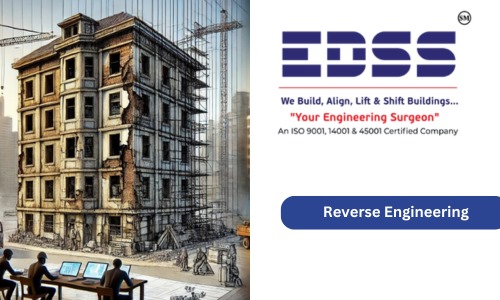
How Reverse Engineering Helps in Structural Analysis & Rehabilitation
In the construction industry, buildings and infrastructure are intended to withstand for decades. Nonetheless, conditions such as foundation collapse, deterioration of materials, seismic activities, design defects, and external influences can cause structural defects over a period of time. Once a building begins showing signs of distress—cracks, settlements, or tilting—reverse engineering is important to identify the problem and apply the right rehabilitation techniques. In this blog, we’ll discuss how reverse engineering is helping structural rehabilitation, the technology behind it, and why it is a first choice over traditional reconstruction. Table of Contents What is Reverse Engineering in Construction? Common Causes of Structural Failures How Reverse Engineering Works Key Techniques in Structural Rehabilitation Advantages of Reverse Engineering in Structural Rehabilitation Conclusion Frequently Asked Questions What is Reverse Engineering in Construction? Reverse engineering in building construction is the examination of a pre-existing structure, determination of weakness or failure, and formulation of a remedial solution to stabilize or improve its stability. Contrary to conventional repairs, the method goes into the very heart of structural failure, making sure that solutions are permanent and scientifically acceptable. Common Causes of Structural Failures Structural collapse can occur owing to various causes: 1. Foundation Collapses Poor ground conditions, unbalanced load transmission, or shallow piling can cause uneven settlement, resulting in cracking and leaning of buildings. Insufficient geotechnical design prior to construction may lead to long-term foundation instability. 2. Material Breakdown & Corrosion Concrete structures suffer from spalling, cracking, and loss of load-carrying capacity with aging due to weathering and moisture ingress. Steel reinforcement within concrete can corrode and cause expansion and internal cracking. 3. Deficiencies in Design & Construction Mistakes in initial design, such as miscalculation of load demands or inferior materials, may result in premature structural wear and tear. Improper construction practices can generate poor joints and improper reinforcement that might fail when stressed. 4. External Causes Seismic movements, floods, and ground vibrations due to heavy traffic or building can impair structures. Environmental exposure in the form of extreme heat, moisture, and chemical reactions could be responsible for long-term deterioration. 5. Neglect of Maintenance & Overloading Those buildings that do not receive routine inspection, repair, and preventive maintenance can end up with severe defects over a period of time. Alterations such as installing additional floors or heavy machinery without supporting the structure can cause collapses. How Reverse Engineering works Reverse engineering service in building construction is a well-coordinated procedure used to identify and solve structural defects. It utilizes a chain of steps aimed at rehabilitating, reinforcing, and improving structures with no destruction at all. Step 1: Detailed Structural Condition Evaluation Upon any rehabbing, an entire structural review is conducted in determining the state of the structure of the building. This comprises: Visual Check-Up: Pinpointing surface visible cracks, listing, and abrasion on building materials. Non-Destructive Testing (NDT):Non-Destructive Testing (NDT) is a group of techniques used to evaluate the properties, integrity, and quality of materials, components, or structures without causing any damage. Load Testing: Assessing the load-bearing capacity of columns, beams, and foundations. Soil Investigation: Verifying changes in soil conditions that could have caused settlement. Step 2: Identifying Root Causes of Structural Failures After data is gathered, engineers inspect the mechanism of failure: Is the foundation collapsing as a result of soil instability? Are cracks structural or not? Is corrosion occurring on reinforcement bars? Are external forces (earthquake, vibration) in play? This aids in deciding on the most appropriate corrective measure for the structure. Step 3: Creating a Rehabilitation Plan A customized solution is created based on the assessment Key Techniques in Structural Rehabilitation 1. Strengthening & Stabilization of Foundation Micropiles & Underpinning: New foundation elements are installed below the structure to supplement support. Jet Grouting & Soil Stabilization: Stabilizes weak soil conditions to avoid future settlement. 2. Structural Strengthening & Crack Repair Epoxy Injection & Grouting: Seals structural cracks and restores load-bearing capacity. Fiber-Reinforced Polymer (FRP) Wrapping: Increases the strength of beams, columns, and walls. Carbon Fiber Reinforcement: Enhances structural strength without adding much weight. 3. Retrofitting to Resist Seismic & Loads Base Isolation Systems: Assists in seismic forces resistance by absorbing the movement of the ground. Shear Wall Strengthening: Enhances lateral load resistance. Jacketing of Columns & Beams: Provides strengthening to critical load-carrying members. 4. Corrosion Prevention & Material Conservation Cathodic Protection: Stops steel reinforcement from further corrosion. Polymer & Waterproof Coatings: Shields structures against moisture and chemical attack. 5. Intelligent Structural Monitoring & Future-Proofing Mounting IoT-based structural health monitoring sensors to monitor vibrations, load fluctuations, and crack growth continuously. Adopting predictive maintenance techniques to avoid future failure. Advantages of Reverse Engineering in Structural Rehabilitation 1. Cost-Saving & Time-Saving Rather than tearing down and rebuilding, reverse engineering involves focused repair, keeping costs in check. Rehabilitation projects are much shorter than full reconstruction, minimizing downtime. 2. Environmentally Sustainable Extends the life of existing structures, minimizing construction waste. employs recycled and high-performance materials for sustainable rehabilitation. 3. Increases Structural Safety & Compliance Restores buildings to current building codes and seismic safety standards. Makes older buildings strong enough to handle future loads and natural disasters. 4. Minimum Disturbance to Occupants Most rehabilitation methods enable buildings to be partially occupied while under repair. Industries, businesses, and residential complexes can continue to operate with little disruption. 5. Long-Term Strength & Guarantee Reverse engineering solutions tend to be backed by long-term guarantees, providing assurance in the rehabilitation process. Includes the latest materials that enhance strength over the lifespan of the original structure. Conclusion Reverse engineering has revolutionized structural rehabilitation, providing a new, low-cost, and sustainable option compared to full-scale architectural reconstruction. With new and better assessment methods, top-of-the-line materials, and state-of-the-art engineering approaches, it is possible to restore, reinforce, and even upgrade buildings beyond their original specifications. For industries, companies, and residents that are faced with structural issues, reverse engineering is the solution to secure, stable, and future-proof structures. As a premier building construction company with expertise in reverse engineering, we specialize in providing quality structural rehabilitation services. If your building is experiencing
How Reverse Engineering Helps in Structural Analysis & Rehabilitation Read More »
