
Introduction
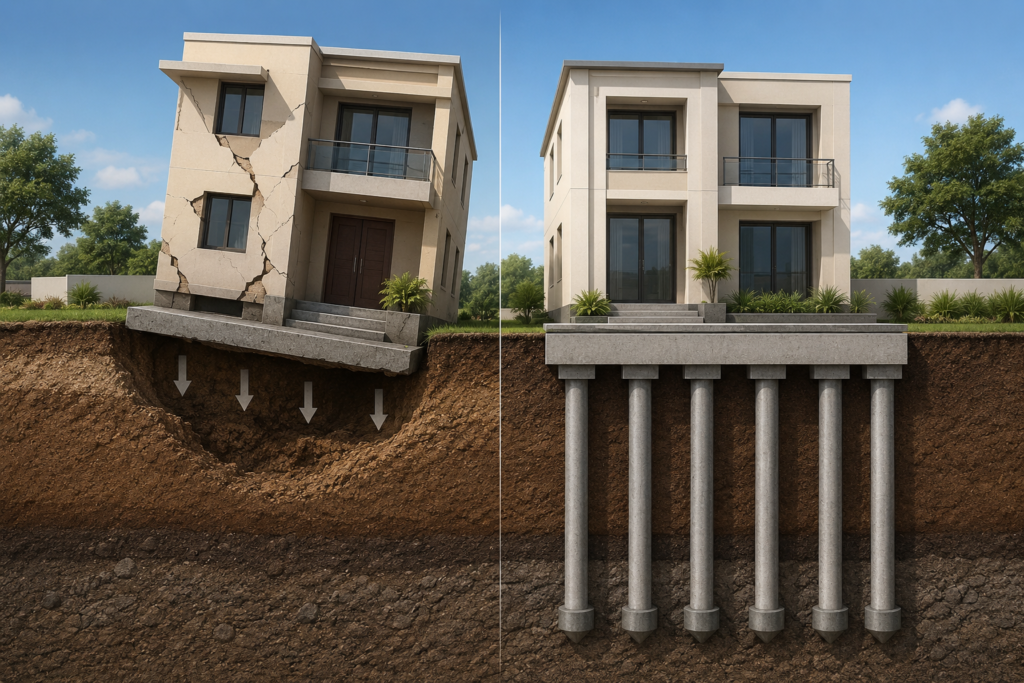
Foundations’ settlements constitute one of the most pressing problems in civil engineering and construction. When a building starts sinking, tilting, or cracking due to the differential movement of ground surface, this is a sign of poor foundation performance. This problem may occur with both residential and commercial buildings, as well as industrial facilities and bridges. Engineering methods of proper foundation reinforcement are what helps secure stable structure safety and longevity.
If the area has variable soil composition, high level of soil moisture, and proximity to a coastline, the problem of settlement will be even more pronounced. This is why structural engineering has been paying particular attention to reinforcement of structures’ foundations lately, both prior to and following construction process. Foundation stability is especially challenging in such cities as Kochi, where soil conditions can differ dramatically within a relatively small distance.
Foundation Reinforcement Experts in Kochi provide professional advice in this matter, while this blog gives some information about the technology of foundation reinforcement and reasons for settlements.
Table of Contents
- Understanding Building Settlement
- Major Causes of Foundation Settlement
- How Foundation Reinforcement Works
- Key Engineering Methods Used in Reinforcement
- Specialized Approach in Coastal Construction Zones
- Benefits of Strengthening Foundations
- Preventive Measures in Construction
- When to Consult Professionals
- Construction Services Overview
- Conclusion
- FAQs
Understanding Building Settlement
Building settlement is the sinking effect on a building as a result of compaction of soils beneath the building. Uniform settlement is common in new buildings, while differential settlement occurs when the foundation experiences a greater load that exceeds its stability.
The two types include:
- Uniform settlement: Sinking effect of a building evenly
- Differential settlement: Sinking of various parts of a building at different rates
Differential settlement is more dangerous than uniform settlement since it results in cracking and other damages.
Major Causes of Foundation Settlement
Some reasons that lead to problems associated with settlements include:
- Soil Conditions Poor – Loosely packed soil cannot bear weight.
- Water Percolation – When there is excess water in the soil, it becomes loose.
- Poor Construction Practices – Wrong construction techniques cause problems.
- Natural Movement in Soils – Clay soils move depending on moisture conditions.
- Weight of Structures – Structures whose weight exceeds soil carrying capacity sink.
How Foundation Reinforcement Works
The foundation reinforcement is aimed at reinforcing the soil or the structural support to ensure the transmission of loads into safe soil layers.
This is achieved in three principal methods:
- Through reinforcement of the soil layer below the structure
- Redistribution of the structural loads
- Transmission of the load into safer soil layers
Today’s reinforcement systems rely on the integration of engineering materials, structural supports, and geotechnics.
Key Engineering Methods Used in Reinforcement
There are various techniques adopted by civil engineers based on the type of soil and the required structure.
- Underpinning – It involves reinforcing existing foundations by driving them further into the soil.
- Pile Foundation Methods – Involves the use of long piles made from steel or concrete, which are driven deep into the soil.
- Soil Stabilization – It involves improving the density of the soil using chemical or mechanical means.
- Grouting Processes – Consist of the injection of cement or other material into the soil.
- Micropiles – These are small diameter piles that can be used in limited spaces.
- Raft Foundation Reinforcement – A large area foundation that evenly distributes the weight.
Specialized Approach in Coastal Construction Zones
In the coastal areas, soil conditions will depend on moisture, salinity, and deposition of sediments. This increases the complexity of designing a proper foundation and calls for unique engineering approaches.
Foundation Reinforcement Engineering in Kochi includes consideration of the levels of the water table, soil erosion in coastal regions, and employing geotechnical engineering methods in choosing suitable reinforcement measures, as well as deploying deep pile systems with effective drainage systems.
Benefits of Strengthening Foundations
Foundation reinforcement offers multiple long-term advantages:
- Prevents structural cracks and damage
- Improves building lifespan
- Enhances load-bearing capacity
- Reduces maintenance costs
- Increases safety for occupants
- Stabilizes uneven ground conditions
It is a crucial investment for both new construction and existing structures showing signs of distress.
Preventive Measures in Construction
Prevention is always more cost-effective than repair. Engineers recommend the following steps:
- Conduct detailed soil testing before construction
- Use appropriate foundation design based on load analysis
- Ensure proper drainage systems around buildings
- Avoid overloading structures beyond design limits
- Monitor early signs of settlement such as cracks or tilting
Foundation Reinforcement in Kochi conditions often require additional geotechnical studies due to varying soil stability across different zones.
When to Consult Professionals
It is imperative to take early action if any settlement indicators come to light. If property owners spot:
- Visible cracks in walls and/or floors
- Unlevel floors or sunken floors
- Doors and windows that do not shut
- A tilted building
- Pooling water around the foundation
The only individuals who can evaluate the extent of the problem are engineers.
Foundation Reinforcement Experts
Professionals with geotechnical expertise can evaluate soil behavior, structural load distribution, and foundation integrity to design effective reinforcement systems tailored to specific site conditions.
Construction Services Overview
Modern civil engineering firms offer integrated solutions that combine design, analysis, and execution for structural safety. These services include:
- Soil investigation and testing
- Structural assessment and load analysis
- Foundation strengthening and repair
- Retrofitting of old buildings
- Geotechnical engineering solutions
- Structural stabilization projects
Engineering and Construction Services in Kochi play a vital role in ensuring safe infrastructure development across residential, commercial, and industrial sectors.
Conclusion
Foundations settling can pose a significant problem when it comes to buildings. But, with the help of appropriate engineering practices and modern materials, it can be solved efficiently. The reinforcement of a foundation goes beyond repairing a problem; it is an investment in your building’s safety.
To achieve this, one needs to understand the behavior of the soil and use the right methods to reinforce their foundation, along with professional advice from engineers.
Protect Your Structure from Settlement Issues
Frequently Asked Questions
Weak soils and irregular load distribution are the leading reasons.
Yes, most of them are solved by strengthening techniques such as piling and underpinning.
Depending on soil quality, when done properly, it will serve for decades.
Yes, soil testing is crucial in establishing proper foundation designs.
This depends on several factors including the size of the structure.
Author

EDSS Ventures Limited is a technology-driven engineering and construction company established in 2003 and transitioned into a public limited company in 2022. The company specializes in innovative civil engineering solutions that focus on repairing, strengthening, and transforming existing structures instead of rebuilding them. Its expertise includes building restructuring, foundation strengthening, correction of tilted structures, lifting and shifting engineering, and restoration of heritage and monumental buildings. EDSS Ventures also delivers advanced waterproofing systems and vertical parking solutions with both automated and manual options. With a strong commitment to sustainability, the company adopts resource-efficient methods that minimize environmental impact while delivering high-quality, customized engineering outcomes.
